Kota Kinabalu website case study
How PixelBah Built the 2KZ Car Rental Website for Kota Kinabalu Customers
2KZ is a Kota Kinabalu car-rental business serving local customers and Sabah visitors. PixelBah shaped its public website around the decisions people make before contacting a rental operator: where the service starts, which vehicles are available, what the displayed rate represents, how airport handover works and how to continue through WhatsApp. This case study documents the verified structure and implementation without claiming unapproved traffic, booking, ranking or revenue results.
Client introduction
2KZ Car Rental operates from the Kota Kinabalu service area and provides self-drive vehicle options for airport arrivals, city travel, business trips, families and groups continuing to other suitable Sabah destinations. Its published fleet includes compact cars, sedans, SUVs, MPVs, a pickup and a passenger van. Customers can review vehicle information online, then ask about availability and handover arrangements through the business's official WhatsApp route.
The website needed to represent a service-area operation accurately. It does not present 2KZ as a walk-in airport counter or promise that every vehicle is available at every time. The public experience explains the service while keeping final availability, deposit, coverage, pickup and return details inside the direct confirmation process. That distinction is important for both customer trust and responsible local search visibility.
PixelBah's role was to turn a practical rental operation into a clear digital experience. The work connects brand presentation, vehicle discovery, booking preparation, local content and measurement-ready interactions. The live site is the authoritative reference for current vehicles, rates and rental information because operational details can change after this case study is published.
Business challenge
A car-rental customer rarely arrives with only one question. They may need to compare seating and luggage space, understand whether KKIA handover can be arranged, decide if a vehicle suits a Kundasang journey, check the displayed daily rate and know what information to send for an availability check. On a generic company page, those questions compete for attention and the customer must rely on a long messaging conversation before they can make a useful comparison.
2KZ therefore needed more than an attractive homepage. The website had to work as a decision system: give each vehicle a stable destination, explain the service area honestly, separate general guidance from booking-specific confirmation and make the next action visible without implying that a form submission reserves a car automatically. Mobile use was especially important because travellers often research transport while moving between airport, hotel and trip-planning contexts.
The commercial challenge was to create a professional business website in Kota Kinabalu that could support discovery and enquiries without exaggeration. That meant balancing persuasive presentation with operational boundaries. The site could show verified rates and vehicle attributes, but it could not promise live inventory, guaranteed delivery, universal discounts or results that had not been measured and approved.
Existing problems
Before a structured website journey is available, rental information tends to become fragmented across social posts, chat history and repeated answers. A prospective customer may see a vehicle image but not its passenger capacity, a rate without the conditions needed for confirmation, or an airport-pickup message without a clear meeting process. Fragmentation increases the amount of clarification required from both the customer and the rental team.
Another problem is the distance between discovery and action. If every visitor is sent directly to a generic WhatsApp conversation, the business receives messages without dates, passenger count, pickup point or preferred vehicle. The customer then waits while the team reconstructs the basic requirements. PixelBah treated the website as preparation for a human confirmation rather than a replacement for it.
Local relevance also needed to be expressed through useful information instead of repeated place names. Kota Kinabalu, KKIA, Kundasang, Ranau and wider Sabah travel are meaningful only when they change the customer's decision. The content architecture therefore connects each location to handover, vehicle choice, route planning or service boundaries. No claim is made that these problems produced a specific loss, conversion rate or ranking before the project. Awaiting client-approved results.
Trust was another design constraint. Rental decisions involve money, identity documents, driving responsibilities and time-sensitive arrival plans. The website therefore needed to make public information useful without encouraging customers to expose private details in analytics or public forms. It also had to state where a general explanation ends and a booking-specific condition begins. Clear limitations are part of the user experience because they reduce the chance that a customer mistakes marketing copy for a confirmed rental agreement.
Research process
The planning process began with the public facts the business could support: its service origin, vehicle categories, confirmed vehicle attributes, displayed daily rates, WhatsApp contact route and the types of journeys customers commonly need to discuss. These facts became the evidence boundary for page copy, structured data and calls to action. Unknown values were not converted into marketing claims.
Customer questions were grouped by intent. Fleet questions belonged on vehicle and category pages. Operational questions belonged in booking, contact, FAQ and rental-terms pathways. Location questions required focused guidance about KKIA handover, Kota Kinabalu travel and suitable onward journeys. This separation helped avoid one overloaded page trying to rank for and answer every subject.
Research also considered what the rental team needs before confirming availability: dates, times, passenger count, pickup area, return plan and a preferred vehicle or category. The website uses those inputs to improve the quality of the handoff while keeping final confirmation with the business. Personal and trip-specific information is not presented as material for public analytics or case-study reporting.
The verified project data was reviewed as a system rather than copied page by page. Vehicle names, categories, seats, transmission and current price fields needed consistent presentation wherever they appeared. Commercial pages needed to reference the same operating boundaries as the booking journey. Frequently asked questions needed to answer recurring concerns without contradicting rental terms. This content modelling reduces accidental inconsistency and gives future updates a known source rather than scattering business facts across unrelated components.
Search intent informed the research but did not replace customer needs. Terms connected to Kota Kinabalu car rental, KKIA pickup, affordable vehicles and Sabah self-drive travel represent different stages and constraints. The final architecture uses those distinctions to decide whether a subject deserves a commercial page, a guide, a fleet path or a concise supporting answer. This protects the site from publishing several pages that compete for the same purpose.
UX strategy
The experience follows a progressive decision path. Visitors first understand the local rental offer, then compare vehicles, review practical details and continue to an availability conversation. Strong actions such as Check Availability, View Cars and WhatsApp booking appear where they match the visitor's stage rather than forcing every section to compete with the same message.
Vehicle cards expose the information needed for an initial comparison: category, seating, transmission and displayed daily rate. Dedicated vehicle pages expand the context and preserve the selected vehicle in the enquiry journey. This reduces the chance that a visitor reaches WhatsApp with no reference to the option they were viewing. It also gives search engines a stable page for each verified vehicle rather than an image-only fleet gallery.
The UX deliberately distinguishes an enquiry from a confirmed booking. Forms and buttons help assemble a request, but the site explains that availability and total price are confirmed manually. That language protects trust and reflects the operating process. It avoids a false real-time booking promise while still giving the customer a clear, low-friction next step.
Website architecture
The architecture combines permanent business pages, vehicle inventory, commercial local pages and educational guides. Core destinations cover the homepage, fleet, individual vehicles, about, contact, frequently asked questions and rental terms. Focused pages address Kota Kinabalu car rental, coordinated KKIA handover, affordable vehicle selection and Sabah self-drive planning. Guides answer narrower trip and vehicle-choice questions.
This structure assigns one primary purpose to each destination. A vehicle page supports evaluation of a specific car. A local commercial page explains a service context. A guide supports research without replacing the booking page. Internal links move visitors between those layers: a guide can recommend relevant vehicles, a vehicle page can link to route guidance, and commercial pages can lead to the availability action.
Bilingual routes support English and Bahasa Malaysia content where an approved version exists. Navigation, canonicals and linked destinations keep language paths distinct. The architecture is designed to grow through verified vehicles and genuinely useful travel questions, not by producing near-duplicate pages for every locality or keyword variation.
Architecture also affects commercial resilience. A social network post can disappear from a feed, and a messaging thread is visible only to its participants, but a stable vehicle or service URL can be revisited, shared and improved. Each useful destination gives 2KZ a controlled place to explain the offer before a customer enters a private conversation. That does not remove the need for responsive human service; it gives that service a more informed starting point.
Mobile optimisation
Mobile optimisation started with the task, not a smaller desktop canvas. The most important information remains readable in a narrow viewport, vehicle cards use stable image areas, controls are large enough to operate by touch and primary actions remain visually distinct. Responsive grids collapse into a natural reading order rather than preserving desktop density on a phone.
The WhatsApp handoff is particularly relevant on mobile because the customer can continue in an installed messaging application. Vehicle and booking context accompanies tracked calls to action without placing private message content inside analytics. Consent controls allow the website's necessary enquiry functions to remain available when optional analytics is rejected.
Responsive behaviour was verified across common viewport sizes during implementation. This statement describes the interface and validation process; it is not a claim about the proportion of customers using mobile devices or an improvement in mobile conversion. Awaiting client-approved results.
SEO implementation
The SEO foundation gives each public destination a descriptive title, meta description, canonical URL and crawlable heading structure. XML sitemap and robots handling support discovery, while internal links connect vehicles, services, destinations and guides according to customer intent. The site uses readable public content rather than hiding essential rental information inside scripts or images.
Structured data represents page context and verified entities. Vehicle pages can describe confirmed vehicle details, while page and breadcrumb markup clarify hierarchy. The website avoids using structured data to invent availability, aggregate ratings or offers that the public page cannot substantiate. Review content displayed on the site remains tied to its stated source.
Local relevance comes from accurate Kota Kinabalu and KKIA service information, not keyword repetition. Pages explain where the journey begins, what handover means and which questions should be confirmed. The project creates a stronger basis for organic discovery, but this case study does not claim that a particular keyword position or traffic increase resulted. Awaiting client-approved results.
Performance optimisation
The implementation uses Next.js rendering and image handling to deliver structured page content efficiently. Image dimensions and responsive sizing reduce unexpected layout movement, reusable components avoid duplicating interface logic, and static generation supports fast delivery for public routes. The design limits heavy effects in the critical customer journey so vehicle information and actions remain the priority.
Performance work also includes behavioural stability. Calls to action do not depend on optional analytics, consent state is handled separately from essential functions, and the booking path continues to work when measurement is declined. This makes performance a combination of loading, layout stability and dependable interaction rather than a single laboratory score.
No fixed Lighthouse score, Core Web Vitals result or before-and-after improvement is published here because a client-approved benchmark has not been supplied for this case study. Awaiting client-approved results.
The static delivery model also supports operational simplicity. Public pages can be generated before release and checked for missing routes, metadata, links and assets as a complete output. This makes regressions easier to identify before files reach the live host. It does not eliminate hosting, caching or third-party variability, but it creates a predictable release artefact that can be verified independently of an editing dashboard.
Technology stack
The verified project repository uses Next.js 15, React 19 and TypeScript. Tailwind CSS provides the styling system, while reusable React components support fleet cards, booking interactions, navigation and shared content patterns. Framer Motion and Three.js are installed in the project where approved interface behaviour requires them, but their presence is not presented as a business outcome.
The website is configured for static export so its public output can be hosted in the client's established web environment. URL generation, localized content, metadata, structured data, sitemap output and verification scripts are part of the implementation. Google Tag Manager can load in production through an environment setting after analytics consent, and the event model covers non-sensitive actions such as vehicle views, filters and WhatsApp enquiries.
Technology choices were evaluated against maintainability and deployment constraints rather than selected as badges. The stack supports reusable data, predictable routes and a testable build while preserving direct customer contact. Hosting ownership, account access and future maintenance remain matters for the agreed client handover and service arrangement.
Business outcome
The completed website gives 2KZ a public, brand-owned destination for its Kota Kinabalu rental service. Customers can compare a published fleet, open individual vehicle pages, review visible rates, understand airport-handover boundaries and prepare a more specific WhatsApp enquiry. The business can point social, referral and search visitors to stable information instead of repeating every introductory answer in a message thread.
For PixelBah, the project demonstrates how website design for a local service business connects content architecture, mobile interaction, technical delivery and an honest conversion path. It is evidence of the work delivered, not evidence of an unverified commercial result. The interface creates opportunities to measure consented events, but an event is not automatically a confirmed rental or revenue outcome.
Traffic, sales, conversion rate, ranking, enquiry volume and return on investment have not been approved for publication. Awaiting client-approved results.
The next evidence step belongs to the client and measurement process. Approved analytics can show how visitors move between fleet, vehicle and enquiry destinations, while operational records can distinguish a message from an actual confirmed rental. Only after the client approves a method and the underlying figures should this case study report quantified outcomes. Until then, the defensible result is the delivered website system and the customer decisions it is designed to support.
This distinction matters for businesses comparing website providers. A case study should show the reasoning, implementation and observable output without turning an interface into a claim about revenue. Prospective PixelBah clients can inspect the live 2KZ experience, review the structure described here and discuss how their own service process differs. Their recommended scope should follow their evidence, customers and operational responsibilities rather than copy a car-rental template.
Project screenshots
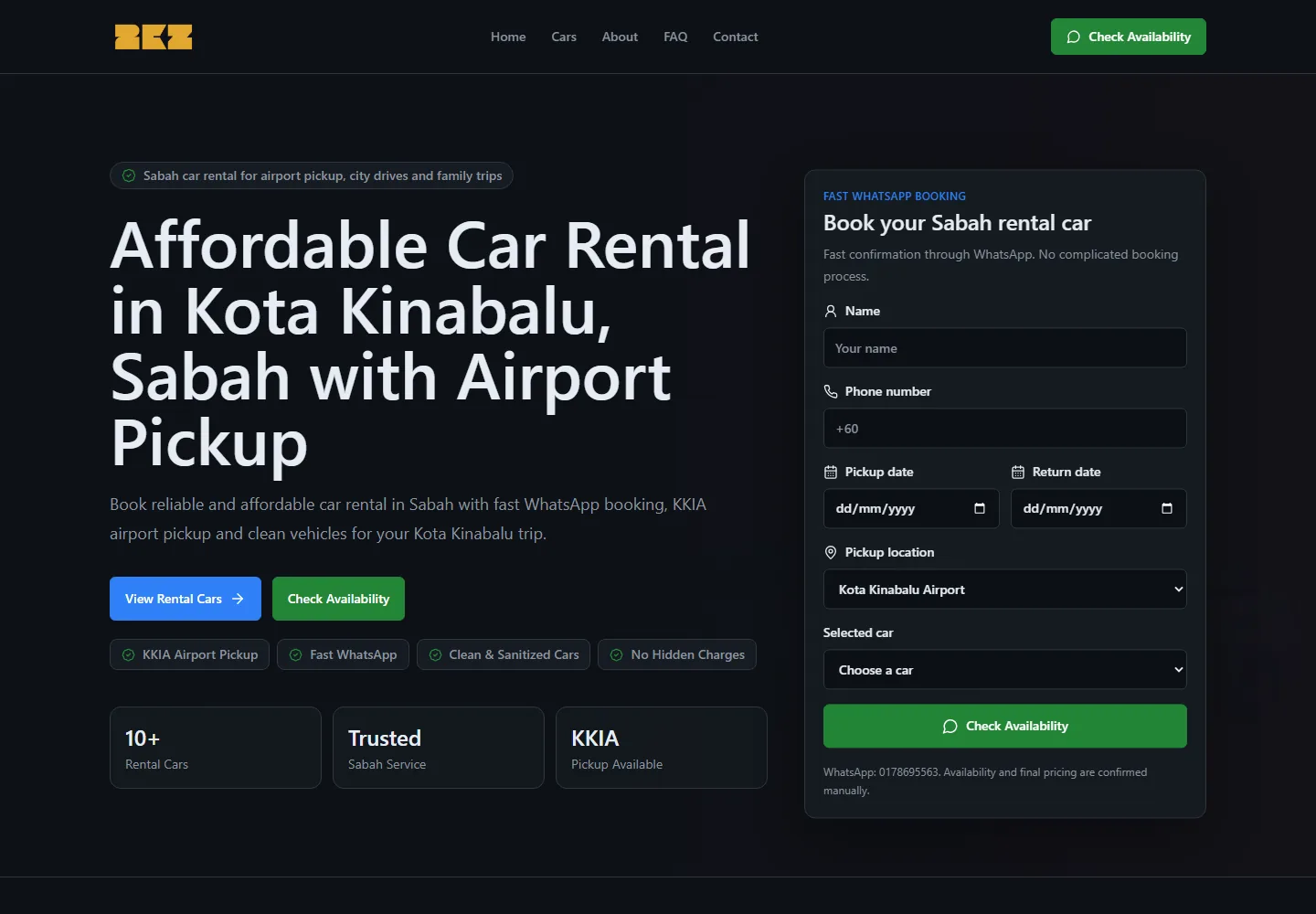
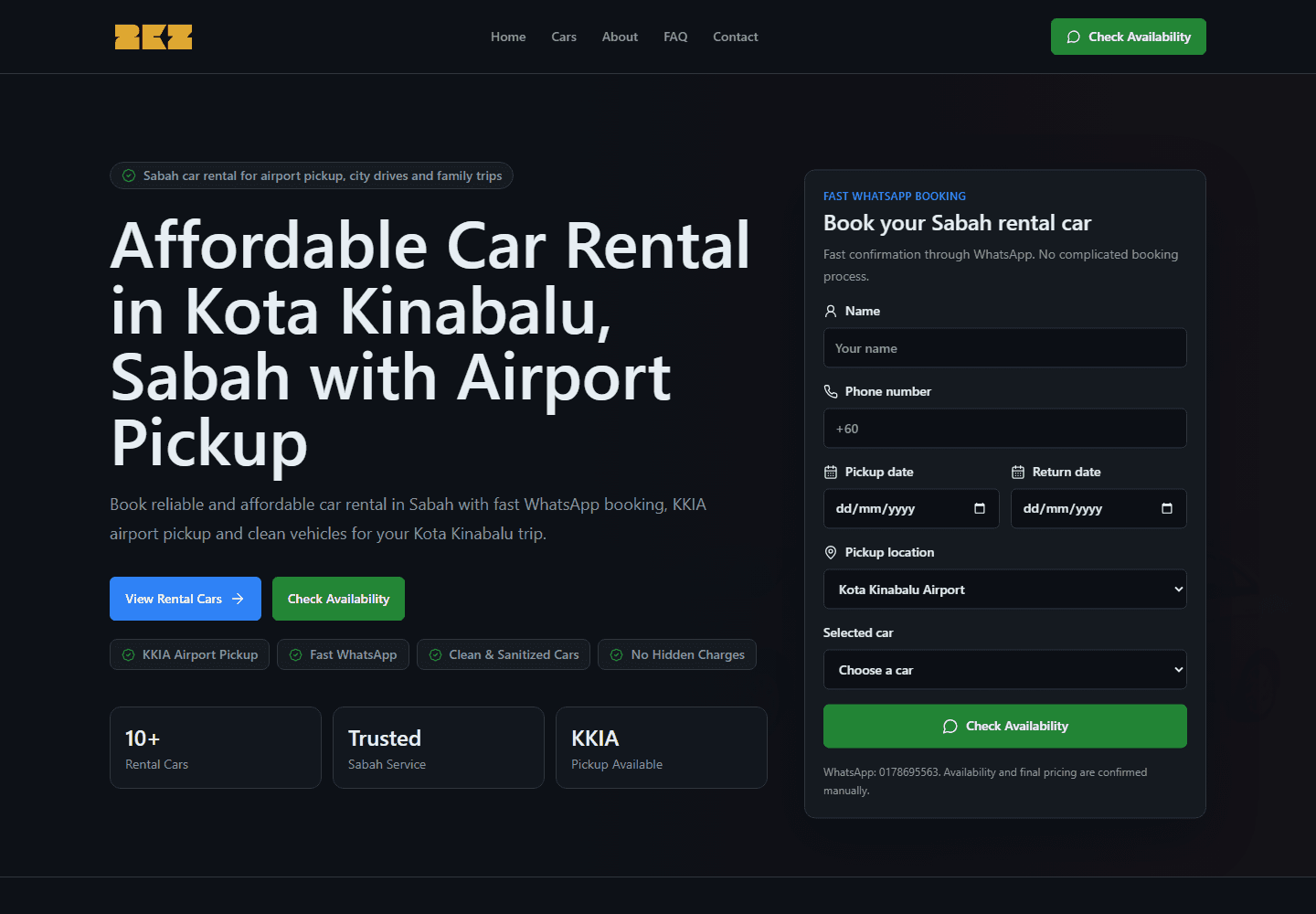
Frequently asked questions
What did PixelBah build for 2KZ Car Rental?
PixelBah built a responsive car-rental website with vehicle discovery, individual vehicle pages, local service content, booking preparation, direct WhatsApp actions and SEO-ready public routes.
Is 2KZ based in Kota Kinabalu?
The website presents 2KZ as a service-area car-rental operation starting from Kota Kinabalu, with KKIA and other handover arrangements subject to confirmation.
Does the website provide live vehicle availability?
No. Customers review published information and send their dates and requirements. 2KZ confirms actual availability and rental details directly.
Was the website designed for mobile customers?
Yes. Vehicle discovery, rental information and WhatsApp actions are arranged for common mobile and desktop screens. No unsupported mobile conversion result is claimed.
What technology does the 2KZ website use?
The verified repository uses Next.js 15, React 19, TypeScript and Tailwind CSS, with a static-export deployment model.
Did the project improve rankings or bookings?
No approved ranking, booking, traffic, sales or conversion result is available for publication. Awaiting client-approved results.
Can PixelBah build a similar business website in Kota Kinabalu?
PixelBah can review the business, customer questions, content, functions and ownership requirements before recommending an appropriate website scope.
Where can I see the live 2KZ website?
The current public website is available at www.2kz.my and remains the authoritative reference for current vehicles, rates and rental information.
Build a clearer local customer journey
Discuss a business website for Kota Kinabalu or Sabah
Start with the services, customer questions, content, functions and ownership your website genuinely needs.